After the Funnel
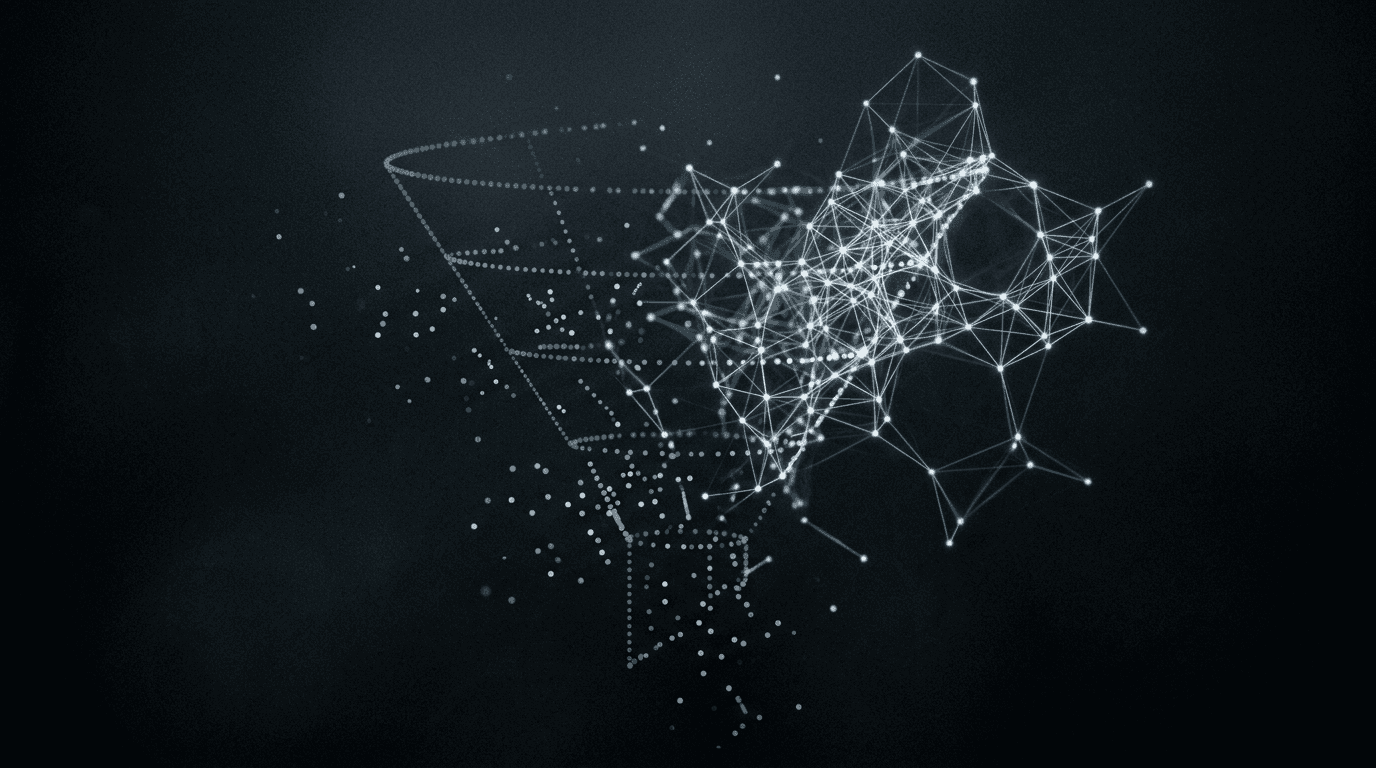
Awareness, consideration, decision, purchase. Neat. Clean. Wrong. Consumer research shows people don't move through stages. They stream, scroll, search, and shop simultaneously. The funnel was always a simplification. It's now a dangerous one, because the metrics built around it are lying to you.
Awareness, Consideration, Decision. RIP.
The marketing funnel has been the default operating model for over sixty years. And it's broken. A 2025 consumer behavior study, "Move Beyond the Linear Funnel," found that consumer behavior no longer follows the awareness-to-purchase sequence that underpins most marketing strategy. The linear path hasn't just gotten more complicated. It's stopped existing for a meaningful share of consumers.
The original model (awareness, consideration, decision, purchase) emerged in an era of controlled media. Television, print, and radio created a relatively predictable sequence. A consumer saw an ad, became aware of a product, evaluated alternatives through a limited set of channels, and made a purchase at a physical location. The stages were distinct because the channels enforced them. You couldn't comparison-shop while watching a television commercial. You couldn't buy a product while reading a magazine review.
That structural separation no longer exists.
A person watching a product review on YouTube can open a browser tab, compare prices, read three Reddit threads, check inventory at a nearby store, and complete a purchase. All within the same session. The stages haven't blurred. They've collapsed into simultaneous, overlapping behaviors that defy sequential mapping. We're witnessing the attention-to-intention shift in real time.
Every marketing plan, every campaign brief, every budget allocation built around "moving people through stages" rests on an assumption the data no longer supports. The funnel was never a perfect representation of how people buy. It was a useful abstraction. The question now is whether that abstraction still earns its place in the strategy deck. Or whether it actively misleads.
The answer is clear: it misleads. It causes marketers to over-invest in stage-specific content, build attribution models around a nonexistent path, and allocate budget to "top of funnel" and "bottom of funnel" as though those designations correspond to something real. When the framework doesn't match behavior, the strategies built on that framework fail in ways that are hard to diagnose. Because the framework itself is never questioned.
The 4S Behaviors: What Happens Now
Four behaviors have replaced the funnel's linear stages: Streaming, Scrolling, Searching, and Shopping. The 2025 consumer behavior research found these behaviors overlap, repeat, and occur simultaneously. Not in sequence. This reframes the entire challenge of marketing strategy from managing a sequence to mapping distributed influence.
Streaming is passive discovery. A consumer watches a creator's video, encounters a product in context, and forms an impression without any active search intent. This isn't "awareness" in the funnel sense. It's ambient exposure embedded in entertainment and information consumption. The consumer isn't at the top of anything. They're engaged in content that happens to contain commercial signals.
Scrolling is social and algorithmic discovery. A consumer moves through feeds (Instagram, TikTok, LinkedIn, X) encountering product mentions, peer recommendations, and brand content in an unpredictable sequence. Scrolling behavior is neither awareness nor consideration. It's a blend of both, filtered by algorithmic selection that no marketer fully controls.
Searching is active inquiry, but it doesn't happen at a predictable stage. A consumer might search before they've seen any brand messaging. They might search after a purchase to validate their decision. They might search mid-scroll because something in their feed triggered curiosity. Search isn't a stage. It's a behavior that fires at any point.
Shopping is transaction behavior, but it's no longer the terminal stage. Consumers browse shopping platforms for discovery, not just purchase. They add items to carts as bookmarks. They compare prices on Amazon while standing in a physical store. Shopping behavior is woven through the entire experience, not isolated at the end.
The Adaptive Commerce research reinforces this from a different angle. A survey of 8,716 consumers across 13 markets (2025) found that commerce is becoming agent-mediated, personalized, and cross-platform. Consumers don't experience brands in channels. They experience them in moments.
And those moments don't follow a map anyone designed.
The practical implication is uncomfortable: you can't fix a path that doesn't have a consistent shape. You can only understand which moments carry influence and invest in being present at those moments with the right signal.
What Do "Influence Maps" Replace?
The 4S framework proposes "influence maps" as the successor to funnel-stage thinking. The research (2025) defines them as frameworks that measure each touchpoint's actual impact on purchasing decisions, combining measurable behavioral data with consumer recall. This replaces the question "where in the funnel does this touchpoint sit?" with "how much did this touchpoint matter?"
The distinction sounds subtle. It isn't.
Funnel-based measurement assumes a path exists and assigns value based on position along that path. First-touch attribution credits the "awareness" moment. Last-touch attribution credits the "decision" moment. Multi-touch attribution distributes credit across the assumed sequence. All three share the same flaw: they assume the sequence is measurable.
Influence maps abandon the sequence entirely. They ask a different question: regardless of when or where a touchpoint occurred, what was its measurable contribution to the outcome? This is closer to how decisions work. A recommendation from a trusted friend might carry more influence than twenty retargeted ads, but funnel attribution would credit the retargeting because it's closer to the conversion event.
Why this matters for how budgets get allocated:
- Funnel metrics assume a path. Influence maps measure impact regardless of path. A YouTube video that plants a preference months before purchase gets measured by its actual influence, not dismissed because it's "too far from conversion."
- Funnel attribution assigns credit to stages. Influence maps assign credit to actual influence. The touchpoint that shaped the decision gets recognized. Whether it occurred first, last, or somewhere the funnel model doesn't even have a name for.
- Funnel thinking allocates budget by stage. Influence thinking allocates budget by measured impact. If organic social drives more purchase influence than paid search, the budget should reflect that. Regardless of which "stage" each channel supposedly serves.
The shift requires better measurement, which is why most organizations haven't made it. Influence mapping demands integration across data sources, sophisticated modeling, and a willingness to challenge the organizational structures built around funnel stages. Many marketing teams are literally organized by funnel position: demand gen, nurture, conversion. Rethinking the model means rethinking the org chart.
That's harder than rethinking a slide deck.
How Is AI Accelerating the Collapse?
AI adoption in marketing has doubled since 2022, and most of it is pointed at the wrong model. The 2025 CMO Survey found AI now powers 17.2% of all marketing activities, with CMOs projecting that figure will reach 44.2% within three years (The CMO Survey, 2025). But here's the irony most vendors won't acknowledge: the majority of AI marketing tools are still built around funnel assumptions.
Automated email sequences assume a nurture path. Retargeting campaigns assume a consideration stage. Lead scoring models assign points based on funnel position. Predictive analytics tools forecast movement through stages. All funnel-native tools running on AI infrastructure. New technology improving an obsolete model. Like putting a jet engine on a horse-drawn carriage.
The more disruptive AI impact is on the consumer side. When an AI agent handles product research, comparison, and recommendation in a single conversational interaction, the stages between awareness and purchase don't just compress. They disappear. A consumer asks ChatGPT or Perplexity for a product recommendation. The AI synthesizes reviews, compares specifications, checks pricing, and delivers a ranked recommendation. All in one response.
Where's the funnel in that interaction?
There isn't one. The consumer went from "I need something" to "here's what to buy" without passing through any identifiable stage. And this behavior is growing. Industry analysts project that by 2026, traditional search engine volume will drop 25% as consumers shift to AI assistants and chatbots for product and service research. That's a quarter of the search behavior that currently feeds funnel-based attribution models. All of it redirected to a channel where the funnel doesn't apply.
So what determines whether your brand shows up in that AI-mediated interaction? Not your position in a funnel. Not your retargeting pixel. It's your entity clarity, your structured data, your topical authority, and the quality of the information associated with your brand across the web. The inputs to AI recommendation are entirely different from the inputs to funnel progression.
What Dies With the Funnel?
If the funnel model is obsolete, then the strategies, metrics, and organizational structures built on it become unreliable. The 2025 consumer behavior research makes this explicit: legacy funnel models both misrepresent and undercount the touchpoints that shape purchase decisions. Being specific about what breaks matters more than vague talk about "transformation."
Attribution models built on funnel stages become unreliable. If there's no linear path, then first-touch, last-touch, and multi-touch attribution (all of which assume a sequence) are measuring a fiction. The models still produce numbers. The numbers just don't correspond to how decisions were made. That's worse than having no data, because it creates false confidence.
"Top of funnel" and "bottom of funnel" content strategies lose coherence. When there's no funnel, there's no top or bottom. A blog post isn't "awareness content." A product comparison page isn't "consideration content." Every piece of content might serve any function at any moment, depending on the consumer's context when they encounter it. Content strategies organized by funnel stage produce content that serves the strategy. Not the consumer.
MQL and SQL definitions that depend on funnel position need rethinking. A marketing qualified lead is typically defined by behaviors that indicate funnel progression: downloaded a whitepaper (consideration), visited pricing page (decision), requested a demo (purchase intent). But if the path isn't linear, a person might visit the pricing page first and read the whitepaper later. Or never. Scoring leads by assumed funnel position misidentifies readiness.
Campaign measurement that tracks "moving people through stages" measures a path that doesn't exist. When a campaign report shows "X% moved from awareness to consideration," what does that mean? It means people exhibited behaviors that someone mapped to those stages. The stages themselves are imposed on the data. They're not observed in it. We've been so accustomed to this framework that questioning it feels almost heretical.
What Replaces It?
The temptation is to replace the funnel with another simple model: a loop, a flywheel, a matrix. The 2025 consumer behavior research suggests the replacement isn't a new shape. It's an entirely different approach to understanding and measuring influence across distributed, nonlinear consumer behaviors.
Simplicity was always the funnel's greatest strength and its core weakness. It gave everyone a shared vocabulary. It made complex behavior legible. But it also made marketers see linearity where none existed, because the model required it. The replacement needs to be more honest about complexity, even if that means it's harder to sketch on a whiteboard.
Influence measurement over funnel tracking. Stop asking "where is this person in the funnel?" and start asking "which touchpoints are shaping decisions?" This requires investing in measurement infrastructure that connects outcomes to influence rather than outcomes to sequence. It's harder. It also reflects reality.
Outcome-based attribution over stage-based attribution. Instead of distributing credit across a modeled sequence, measure what contributed to the result. Did this content generate a sale? Did this social post drive consideration? Attribute based on observed influence, not assumed position.
Real-time improvement over campaign cycles. Funnel-based marketing operates in campaigns: a set of activities designed to move people through stages over a defined period. Influence-based marketing operates in continuous improvement: monitoring which signals carry influence and adjusting investment in real time.
AI-readable brand presence over funnel-stage content. As AI agents mediate more purchase decisions (and the projected 25% decline in traditional search suggests this shift is accelerating) the brands that win are the ones AI systems can understand, trust, and recommend. That means structured data, entity clarity, and authoritative content. Not a library of gated PDFs designed for "middle of funnel."
What Does This Mean for Digital Experience Design?
The death of the funnel has direct implications for how websites, apps, and digital platforms are designed. The Adaptive Commerce research across 8,716 consumers (2025) found digital experiences must now serve fragmented, nonlinear, and context-dependent behaviors. Not guide people through a predetermined sequence.
Websites can't be organized by funnel stage. The classic information architecture (blog posts for awareness, case studies for consideration, pricing pages for decision) assumes visitors arrive at the "right" entry point and progress through content in order. They don't. Someone might land on your pricing page from an AI recommendation, your case study from a social share, or your blog from a search query that has nothing to do with your intended funnel position. Every page needs to stand on its own.
Every page needs to serve intent directly. A visitor might arrive from any context with any level of readiness. If your product page assumes the visitor already understands your value proposition because they "should have" read the awareness content first, you lose the sale. If your homepage assumes first-time visitors who need education, you frustrate the referral who already knows what you do and wants to get started. Design for the intent of the visit, not the assumed stage.
Content architecture matters more than content volume. The funnel model encouraged high-volume content production: content for every stage, every persona, every keyword variation. The influence model favors depth and authority. Be the definitive source on your subject rather than producing thin content mapped to stages that don't exist. One complete, authoritative resource outperforms ten stage-specific blog posts. That's true for human readers and for AI systems that prioritize entity authority.
Measurement needs to shift from "where in the funnel" to "did this contribute to a decision." Page analytics organized by funnel stage (awareness content gets X visits, consideration content gets Y visits) tell you nothing about influence. The better question: which pages are present in paths that result in outcomes? Which content is recalled by buyers as influential? Proving marketing value requires answering those questions. It's also the only measurement that matters.
What does this look like in practice? Designing every digital touchpoint as though it might be the only one a consumer ever sees. Because increasingly, it might be.
What to Build Instead
AI marketing adoption has doubled since 2022, yet most organizations still plan, measure, and allocate budget against a linear funnel (The CMO Survey, 2025). That gap between how consumers behave and how marketing is organized is the most immediate competitive opportunity available. A modern marketing growth strategy starts by retiring the funnel.
1. Stop organizing content by funnel stage. Organize by intent and topic authority. Audit your content library. If you've got folders or categories labeled "TOFU," "MOFU," and "BOFU," that's a signal your strategy is built on obsolete assumptions. Reorganize around topics your brand has authority on, and make sure every piece of content serves a specific user intent. Not a funnel position.
2. Replace funnel-stage metrics with influence metrics. This is the hardest transition because it requires new measurement infrastructure. Start by surveying buyers: what touchpoints do they recall? What influenced their decision? Combine survey data with behavioral analytics to build a picture of actual influence. The influence mapping approach from the 4S framework (2025) provides a methodology for this shift.
3. Audit your marketing tools for funnel assumptions. Look at every tool in your stack. Does your marketing automation platform assume a linear nurture sequence? Does your CRM score leads by funnel position? Does your analytics platform report by funnel stage? You may be using AI-powered tools to improve a model that doesn't match reality. That's an expensive mismatch.
4. Build every page to serve intent directly. Assume the visitor could arrive from any context: an AI recommendation, a social share, a direct link from a colleague, a search query you didn't anticipate. Does the page answer the intent of the visit without requiring the visitor to have seen any other page on your site? If not, redesign it.
5. Invest in AI-readable brand presence as the new discovery layer. Structured data, entity clarity, consistent NAP information, authoritative content, and strong backlink profiles are the inputs that determine whether AI systems can understand, trust, and recommend your brand. This isn't SEO in the traditional sense. It's ensuring your brand is legible to the systems that increasingly mediate purchase decisions.
The Path Forward
The funnel was always a simplification. For decades, it was a useful one. It gave marketers a shared language for describing complex behavior. It provided a framework for budget allocation that, while imperfect, was at least consistent. It organized teams, campaigns, and measurement around a coherent (if inaccurate) model of how people buy.
But useful simplifications become dangerous when they stop reflecting reality. And the evidence is now overwhelming. The 4S behaviors framework (2025), the Adaptive Commerce consumer research across 13 markets (2025), industry projections on search behavior shifts, and the CMO Survey data on AI adoption in marketing (The CMO Survey, 2025) all point in the same direction: the linear path is gone.
What remains is influence: distributed, nonlinear, and increasingly mediated by AI systems that don't care about your funnel stages. The organizations that adapt their strategy, measurement, and digital architecture to this reality will have a structural advantage. Not because they adopted a new buzzword, but because their model of consumer behavior finally matches actual consumer behavior.
The ones still building for a funnel that doesn't exist will keep producing dashboards that look right, running campaigns that follow the playbook, and wondering where their customers went.